

-
 March 19, 2026
 -
 5 Comments
 -
 By
er.varunvohra
By
er.varunvohra


 By
By What Are The Courses Available In India To Pursue After 12th?
What Are The Courses Available In India To Pursue After 12th?
Introduction: Navigating Your Future After 12th Grade
The completion of 12th grade marks a significant crossroads for students in India, presenting a spectrum of educational and career opportunities. This pivotal moment often elicits a mix of excitement and apprehension as young minds grapple with the multitude of choices that lie ahead. The academic landscape is vast, encompassing traditional streams, emerging technologies, and skill-based training, each offering a unique pathway toward a fulfilling career. Understanding this diverse ecosystem is crucial for making an informed decision that aligns with individual aspirations, strengths, and the evolving demands of the global job market. This guide aims to demystify the options available, providing a clear and comprehensive overview of the courses one can pursue after completing their 12th standard examinations.
The Pivotal Decision After 12th Standard
The transition from secondary to higher education is more than just an academic step; it’s a foundational decision that shapes future career trajectories and personal development. In India, the post-12th decision is particularly significant due to the structured nature of its education system and the rapidly changing economic landscape. Students are faced with choosing not only a specific course but also a broad academic stream that will influence their foundational knowledge and skill development. This choice requires careful consideration of personal aptitude, long-term career goals, and market relevance.
Understanding the Landscape of Academic Streams and Career Paths
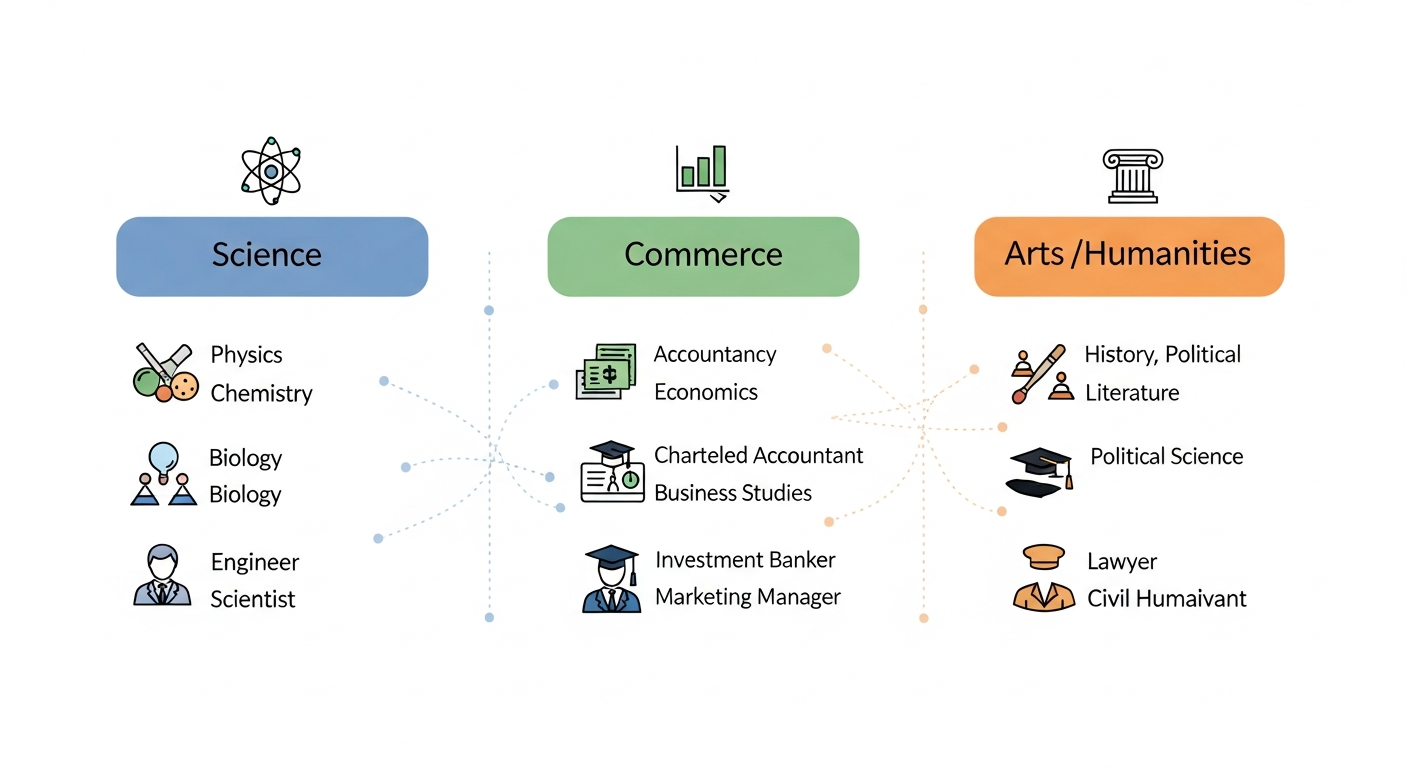 The three primary academic streams in India—Science, Commerce, and Arts—and some of the common career pathways they open up.
India’s higher education system is broadly categorized into three primary academic streams: Science, Commerce, and Arts (or Humanities). These streams serve as the initial filters, guiding students towards specific disciplines. However, it is important to recognize that the boundaries between these streams are becoming increasingly fluid, with interdisciplinary studies gaining prominence. Understanding the general focus and potential career paths associated with each stream is the first step in navigating the vast array of available courses.
Purpose of This Guide: Empowering Informed Choices
This guide is designed to be a comprehensive and neutral resource for students, parents, and educators seeking clarity on the diverse course options available after 12th grade in India. We aim to provide an in-depth exploration of academic streams, specific course offerings, vocational training, and emerging fields, coupled with practical advice on making an informed decision. Our objective is to empower readers with the knowledge necessary to chart a course that not only meets their academic interests but also prepares them for a successful and rewarding future in a dynamic world.
Understanding India’s Academic Streams: Your Foundational Choices
The academic journey after 12th grade in India typically begins with selecting one of the three established streams: Science, Commerce, or Arts/Humanities. Each stream offers a distinct set of subjects and prepares students for different sets of professional disciplines. While these streams provide a framework, modern education increasingly encourages interdisciplinary learning, allowing students to blend knowledge from various fields.
The Science Stream: Gateway to Technical, Medical, and Research Fields
The Science stream is often perceived as the most rigorous, focusing on subjects like Physics, Chemistry, Mathematics, and Biology. This stream is a direct pathway to careers in medicine, engineering, research, and various applied sciences. Students who opt for 12th science develop strong analytical, problem-solving, and critical thinking skills, which are highly valued across a wide range of professions. The foundation laid in subjects like Physics and Chemistry is essential for understanding complex technical and scientific principles.
The Commerce Stream: For Business, Finance, and Management Aspirants
The Commerce stream is designed for students with an inclination towards business, finance, economics, and management. Core subjects typically include Accountancy, Economics, Business Studies, and often Mathematics. Graduates from this stream are well-suited for careers in banking, finance, accounting, marketing, human resources, and entrepreneurship. The curriculum emphasizes financial literacy, economic principles, and business operations, providing a solid grounding for roles in the corporate world.
The Arts/Humanities Stream: Exploring Creativity, Social Sciences, and Liberal Arts
The Arts and Humanities stream encompasses a broad spectrum of subjects, including History, Literature, Political Science, Sociology, Psychology, Philosophy, and Fine Arts. This stream fosters critical thinking, communication skills, creativity, and a deep understanding of human society and culture. Graduates pursue careers in journalism, law, civil services, social work, education, design, media, and various creative industries. It offers a flexible foundation for exploring diverse intellectual interests.
In-Depth Course Exploration by Academic Stream
Once the foundational stream is chosen, students can delve into specific degree and diploma programs. These courses build upon the knowledge gained in 12th grade, offering specialized training and pathways to specific professions.
Courses After 12th Science Stream
The Science stream opens up a plethora of advanced course options, broadly categorized into medical, engineering, and pure science disciplines, along with emerging technology-focused programs.
- Medical and Healthcare: The most sought-after medical course is MBBS (Bachelor of Medicine, Bachelor of Surgery). Other allied health science courses include Bachelor of Dental Surgery (BDS), Pharmacy, Nursing, Physiotherapy, Biotechnology, and various paramedical programs. These require a strong understanding of Biology and Chemistry. The National Medical Commission (NMC) reports that as of the academic year NEET 2024–25, India has a total of 1,18,148 MBBS seats available for aspiring medical students NEET support.
- Engineering and Technology: This field offers numerous specializations. Core branches include Mechanical, Civil, Electrical, and Electronics Engineering. High-demand areas include Computer Science Engineering, Information Technology (IT), and specialized fields like Aerospace, Chemical, and Environmental Engineering. The All India Council for Technical Education (AICTE) data for 2024-25 shows an approved intake of 14.90 lakh (1.49 million) undergraduate engineering and technology programs, marking a significant increase in available seats AICTE Data.
- Pure Sciences: Bachelor of Science (B.Sc.) degrees in Physics, Chemistry, Mathematics, Biology, Statistics, Environmental Science, and Forensic Science offer pathways to research, academia, and specialized roles in various industries.
- Data Science and AI Foundations: Many science graduates pursue undergraduate programs that provide a strong mathematical and computational foundation, preparing them for advanced studies in Data Science and Artificial Intelligence.
Courses After 12th Commerce Stream
Students from the Commerce stream have diverse options that focus on the world of business, finance, and management.
- Accounting and Finance: Professional courses like Chartered Accountancy (CA), Company Secretary (CS), and Cost and Management Accountancy (CMA) are highly regarded. Undergraduate degrees include Bachelor of Commerce (B.Com), often with specializations in Accountancy, Taxation, or Financial Management.
- Business Administration and Management: Bachelor of Business Administration (BBA) is a popular choice, offering specializations in Marketing, Human Resources, Operations, and Finance. Bachelor of Management Studies (BMS) is another equivalent degree.
- Economics: A Bachelor of Arts (B.A.) in Economics or a Bachelor of Science (B.Sc.) in Economics provides a strong foundation for careers in economic analysis, policy-making, and financial services.
- Information Technology and Data: Students can pursue a Bachelor of Computer Applications (BCA) or B.Sc. in Information Technology, which can lead to roles in software development, system analysis, and IT management. An increasing number of B.Com programs now offer specializations in Data Analysis and IT, bridging commerce with technology.
Courses After 12th Arts/Humanities Stream
The Arts stream offers a wide array of creative, analytical, and social science-focused programs.
- Law: Integrated Bachelor of Laws (LLB) programs (e.g., BA LLB, BBA LLB) are available after 12th grade, preparing students for legal practice and related fields.
- Media and Communication: Courses like Bachelor of Journalism and Mass Communication (BJMC), Advertising and Public Relations (PR), and Film and Television production equip students for careers in media, advertising, and public relations.
- Design: Bachelor of Design (B.Des) programs cover disciplines such as Fashion Design, Interior Design, Graphic Design, and Animation. These courses are highly creative and demand a strong portfolio.
- Social Sciences and Humanities: Bachelor of Arts (B.A.) degrees in Psychology, Sociology, Political Science, History, Philosophy, and English Literature offer broad educational foundations for careers in research, teaching, civil services, and social work.
- Hospitality and Tourism: Bachelor of Hotel Management (BHM) programs prepare students for careers in the hospitality industry, including hotel operations, event management, and tourism.
- Fine Arts and Performing Arts: Bachelor of Fine Arts (BFA) and Bachelor of Performing Arts (BPA) degrees cater to students passionate about painting, sculpture, music, dance, and theatre.
Vocational and Skill-Oriented Courses: Practical Pathways to Employment
Beyond traditional degree programs, vocational and skill-oriented courses offer direct routes to employment by imparting practical, hands-on training in specific trades and professions. These courses are often shorter in duration and more job-focused.
Polytechnic Courses: Diploma in Engineering, Technology, and Applied Arts
Polytechnic institutes offer diploma courses, typically of three years duration, in various branches of engineering (e.g., Mechanical, Civil, Electrical, Computer Science) and applied arts. These diplomas equip students with practical skills and knowledge, making them eligible for entry-level technical positions or for further studies. They provide a solid foundation for those who prefer hands-on work or wish to enter the workforce sooner.
ITI (Industrial Training Institute) Programs
Industrial Training Institutes (ITIs) offer certificate courses in a wide range of vocational trades, such as Electrician, Fitter, Welder, Plumber, Computer Operator and Programming Assistant, and Mechanic. These programs are designed to impart specific job skills, leading to direct employability in manufacturing, construction, and service sectors. ITI courses are often short-term and highly practical.
Specialized Skill Development Programs
Numerous government and private organizations offer specialized skill development programs tailored to industry needs. These can range from short-term courses in digital marketing, web development, and graphic design to longer programs in areas like advanced manufacturing and healthcare support. These programs focus on equipping individuals with the specific competencies required by employers, enhancing their employability.
High-Demand and Future-Ready Courses (Transcending Traditional Streams)
The rapid pace of technological advancement has created a demand for specialized skills in emerging fields that often transcend traditional academic stream boundaries. Pursuing courses in these areas can offer significant career advantages.
Data Science & Analytics
The field of Data Science and Data Analysis is booming, driven by the exponential growth of data. Professionals in this domain extract insights from large datasets to inform business decisions. Undergraduate and postgraduate courses in Data Science, Analytics, and Statistics are increasingly popular. Students from Science, Commerce, and even Arts backgrounds can pursue these fields with the right foundational knowledge and specialized training. Skills in programming languages like Python and R, along with statistical knowledge, are crucial.
Artificial Intelligence (AI) & Machine Learning (ML)
Artificial Intelligence (AI) and Machine Learning (ML) are revolutionizing industries by enabling machines to learn and perform tasks that typically require human intelligence. Courses in AI and ML, often at the postgraduate level or as specializations within Computer Science, focus on algorithms, neural networks, and predictive modeling. A strong background in mathematics and programming is essential for these roles.
Cybersecurity & Cloud Computing
With increasing digitalization, Cybersecurity has become paramount to protect sensitive information and systems. Cloud computing platforms, such as AWS, Azure, and Google Cloud, are transforming how businesses operate. Specialized courses and certifications in Cybersecurity and Cloud Computing are in high demand, offering lucrative career opportunities for individuals with strong technical aptitudes.
Robotics & Automation and Internet of Things (IoT)
The integration of Robotics and Automation, along with the Internet of Things (IoT), is transforming manufacturing, logistics, and everyday life. These fields involve designing, building, and managing intelligent systems and connected devices. Courses in Mechatronics, Robotics Engineering, and IoT offer pathways to innovation in these rapidly evolving sectors.
User Experience (UX) and User Interface (UI) Design
In the digital age, creating intuitive and engaging user experiences is critical for the success of software applications, websites, and digital products. User Experience (UX) and User Interface (UI) Design courses focus on understanding user needs, designing user-friendly interfaces, and ensuring seamless interaction. These roles often require a blend of creativity, technical understanding, and user empathy, attracting individuals from diverse academic backgrounds, including Arts and Design.
Digital Content Creation and Management
The digital landscape demands constant creation and management of content across various platforms. Courses in Digital Marketing, Content Strategy, Social Media Management, and Digital Content Creation are highly relevant. These programs equip individuals with skills in writing, multimedia production, SEO, and analytics, making them valuable assets for businesses aiming to establish a strong online presence.
Making an Informed Decision: Your Roadmap to the Right Course
Choosing the right course after 12th grade is a multifaceted process that requires introspection, thorough research, and strategic planning. It is not merely about selecting a degree but about identifying a path that fosters growth, aligns with passion, and leads to professional fulfillment.
Self-Assessment and Introspection: Understanding Your Strengths and Interests
The first and most crucial step is self-reflection. Students should honestly assess their strengths, weaknesses, interests, and values. What subjects do they genuinely enjoy? What kind of problems do they like to solve? Are they more inclined towards analytical thinking, creative pursuits, or interpersonal interactions? Understanding these intrinsic factors is key to selecting a course that will be engaging and sustainable in the long run.
Thorough Research: Beyond the Course Brochure
Once a general direction is identified, extensive research is paramount. This involves exploring various college websites, understanding the curriculum of different courses, and looking into the faculty’s expertise. Reading about career prospects, industry trends, and alumni success stories provides valuable insights. Connecting with professionals in fields of interest, attending career fairs, and seeking guidance from counselors can offer practical perspectives that brochures alone cannot provide.
Understanding Eligibility Criteria and Admissions Process
Each course and college has specific eligibility criteria, which typically involve minimum marks in 12th grade, often in specific subjects relevant to the chosen stream. Many popular courses, especially in medicine (MBBS) and engineering (JEE), require clearing highly competitive Exams. Understanding the application deadlines, required documentation, and the admission process (including any entrance exams, interviews, or group discussions) is essential for a smooth application journey.
Considering Career Prospects and High Salary Courses
While passion is important, considering the career prospects and potential earning capacity of a chosen field is also a practical necessity. Researching which courses typically lead to high-demand jobs and competitive salaries can guide decision-making. Fields like Data Science, Artificial Intelligence, Information Technology, Engineering, and Medicine are often associated with strong career growth and financial rewards. However, it is vital to balance this with genuine interest and aptitude.
The Critical Role of Soft Skills
Regardless of the academic stream or chosen course, the development of soft skills is indispensable for career success. Skills such as effective communication, teamwork, leadership, critical thinking, adaptability, and time management are highly valued by employers across all industries. These skills enhance one’s ability to navigate the professional world, collaborate effectively, and adapt to changing work environments, complementing the technical knowledge gained through formal education.
Confused?
Clear Your Career Confusion With Our Expert Counsellor
Conclusion
The landscape of academic and vocational courses available in India after 12th grade is remarkably diverse and continuously evolving. From the foundational streams of Science, Commerce, and Arts, students can embark on specialized journeys in fields as varied as medicine and engineering to cutting-edge disciplines like Data Science, Artificial Intelligence, and Cybersecurity. Vocational and skill-based programs offer practical, employment-oriented pathways, complementing traditional academic routes.
The decision-making process should be guided by a blend of self-awareness, diligent research into specific courses and colleges, and an understanding of eligibility criteria and admission Exams. It is also prudent to consider long-term career prospects and the growing importance of Data Analysis and digital skills. Ultimately, the most successful path is one that harmonizes personal interests and aptitudes with the demands of the future job market, further enhanced by the cultivation of essential soft skills. By approaching this critical juncture with a clear strategy and a commitment to lifelong learning, students can confidently navigate their future and build a rewarding career.