
-
 July 21, 2026
 -
 0 Comments
 -
 By
The Career Galaxy Brand Desk
By
The Career Galaxy Brand Desk


 By
By Career Switching Into AI Becomes Easy: These 3 Programs Are Supporting the Shift
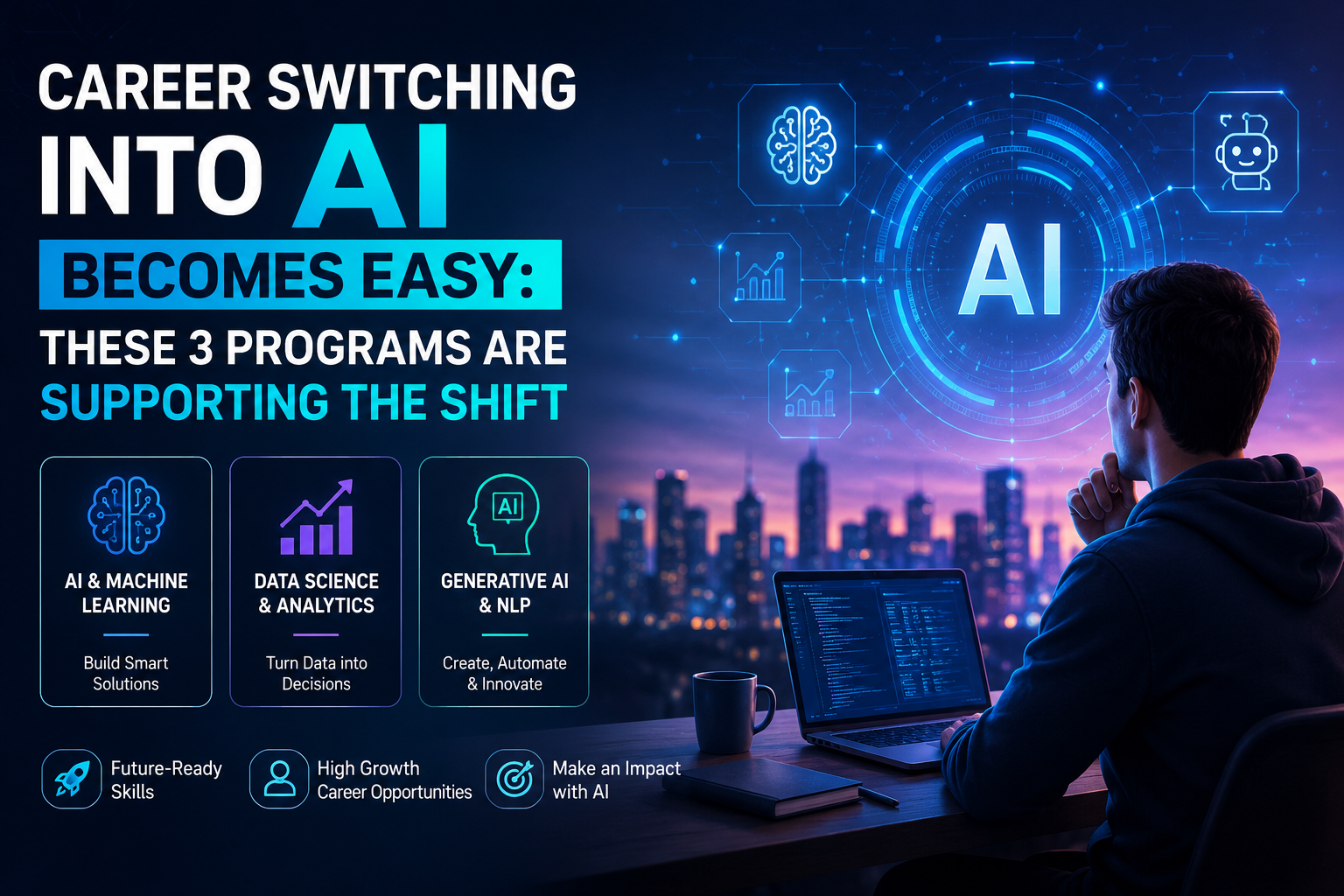
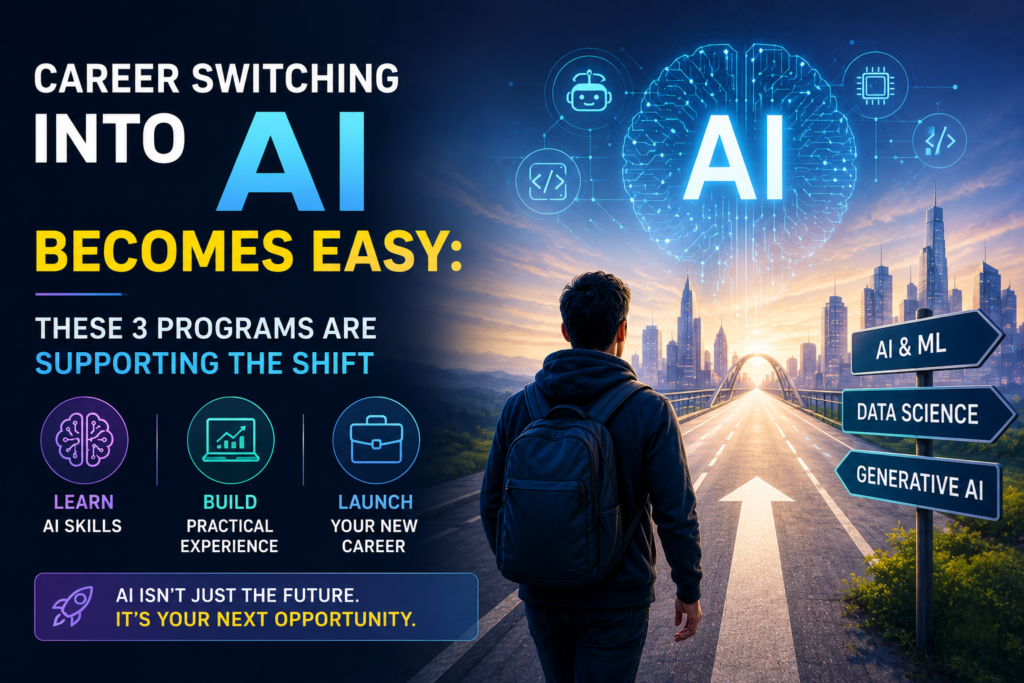
Career Switching Into AI Becomes Easy: These 3 Programs Are Supporting the Shift
Artificial intelligence is rapidly becoming one of the most accessible career transitions for professionals across technology, consulting, analytics, marketing, and operations. Just a few years ago, moving into AI often meant piecing together online certifications, open-source projects, and self-directed learning. While those pathways helped many professionals enter the field, employers today increasingly expect something more than familiarity with AI tools. They want people who can build, deploy, and work with AI systems in production environments.
The shift is already reflected in workforce trends. According to a TechRadar workforce survey, 69% of professionals expect AI to impact their jobs within the next two years, while 63% admit they have overstated their AI skills to remain competitive. The challenge is no longer access to AI education but proving practical capability in a rapidly evolving job market.
This changing landscape is encouraging professionals to look beyond short courses and towards structured postgraduate programmes. Increasingly, AI engineering colleges in India are redesigning learning around industry workflows, product development, and real-world implementation rather than classroom instruction alone. At the same time, leading AI colleges in India are introducing specialised AI degrees that help learners build demonstrable portfolios, gain mentorship from practitioners, and develop the execution capabilities employers increasingly value.
For professionals planning a serious career switch into artificial intelligence, these four programmes represent different pathways into one of the fastest-growing areas of technology.
1. Masters’ Union
For many professionals, switching into AI is less about learning new concepts and more about understanding how to apply their existing experience in an AI-first environment. Software engineers, analysts, consultants, product managers, and operations professionals often possess strong domain expertise but lack a structured pathway to translate those skills into AI careers. Masters’ Union’s Post Graduate Programme in Applied AI & Agentic Systems is designed around bridging that gap.
The full-time, 15-month programme combines AI engineering, product, and business to help learners transition into the interdisciplinary AI roles employers increasingly seek. The first four terms build deep AI and machine learning foundations, while the
final two open into specialised tracks in AI Product, Advanced AI/ML & Systems, and AI Entrepreneurship, preparing graduates for roles such as Forward Deployed Engineers and AI Product Managers. Recognising that AI evolves too quickly for static syllabi, the curriculum is refreshed every term in collaboration with experts from Google, Amazon, Microsoft, Atlassian, IBM, and PayPal to keep pace with the latest technologies and enterprise practices.
Learning extends beyond the classroom through build studios, collaborative product sprints, hackrooms, and mentorship from more than 200 founders, CTOs, and AI operators. By graduation, students have built six production-grade AI systems spanning autonomous AI agents, enterprise AI deployments, Retrieval-Augmented Generation (RAG) pipelines, knowledge graphs, fine-tuned frontier and open-source models, and agentic AI applications. In the final terms, they can further push the frontier by deploying their own Small Language Models (SLMs), building Physical AI and multi-agent enterprise systems, or even launching an AI venture, helping career switchers graduate with both the skills and portfolio needed to enter the AI job market.
2. International Institute of Information Technology Bangalore
For professionals looking to transition into AI without stepping away from their careers, IIIT Bangalore offers a structured pathway that combines academic rigour with industry-oriented learning. Its Executive Post Graduate Programme in Applied AI and Agentic AI is designed for working professionals who want to strengthen their technical capabilities while applying new concepts alongside their existing roles.
The seven-month programme covers emerging areas such as AI agents, Retrieval-Augmented Generation (RAG), Generative AI, and enterprise AI applications through more than 30 industry projects and a capstone. Rather than
relying solely on theoretical instruction, the curriculum encourages learners to apply AI concepts across practical business and technology use cases, helping them build confidence in implementing modern AI solutions.
Among the growing number of AI engineering colleges in India, IIIT Bangalore has established a reputation for combining technical depth with practical learning. Its executive format makes it particularly suitable for professionals seeking a guided transition into AI while balancing ongoing work commitments. For learners who value a structured academic environment and progressive skill development, it offers one of the more established pathways within the evolving landscape of AI colleges in India.
3. Indian Institute of Technology Madras
Not every professional switching into AI is looking to become an AI engineer. Many are aiming to understand how artificial intelligence can improve decision-making, automate workflows, and create value within their existing functions. IIT Madras addresses this need through its Executive Programme in Generative AI and Agentic AI Tools for Business.
Designed for working professionals, the four-month programme requires 8 to 10 hours of study each week and focuses on applying AI across business environments rather than building complex AI systems from scratch. Participants gain exposure to Generative AI, AI-powered workflow automation, no-code and low-code tools, prompt engineering, and practical business use cases that can be implemented within their organisations.
Among the established AI engineering colleges in India, IIT Madras offers a pathway for professionals seeking to integrate AI into leadership, consulting, operations, and business functions. Its flexible format makes it particularly relevant for those who want to develop AI capabilities while continuing to work, reflecting how AI degrees are evolving to serve a broader range of professionals beyond traditional engineering roles.
AI Engineering Colleges in India Are Making Career Switches More Structured
Career transitions into artificial intelligence are becoming less dependent on
self-learning and increasingly shaped by structured postgraduate programmes. While institutions such as IIIT Bangalore and IIT Madras offer valuable pathways through technical learning and business-focused AI adoption, the broader shift is towards programmes that combine knowledge with demonstrable application.
In this context, Masters’ Union’s Post Graduate Programme in Applied AI & Agentic Systems reflects how AI engineering colleges in India are evolving to support professionals changing careers rather than simply upgrading skills. By integrating continuous product development, practitioner mentorship, and real-world implementation into the learning journey, it mirrors the capabilities employers increasingly expect from AI talent. As organisations continue to prioritise practical experience alongside technical expertise, the next generation of AI degrees is likely to be defined by how effectively they prepare professionals to make successful career transitions into AI.