
-
 June 27, 2026
 -
 0 Comments
 -
 By
The Career Galaxy Brand Desk
By
The Career Galaxy Brand Desk


 By
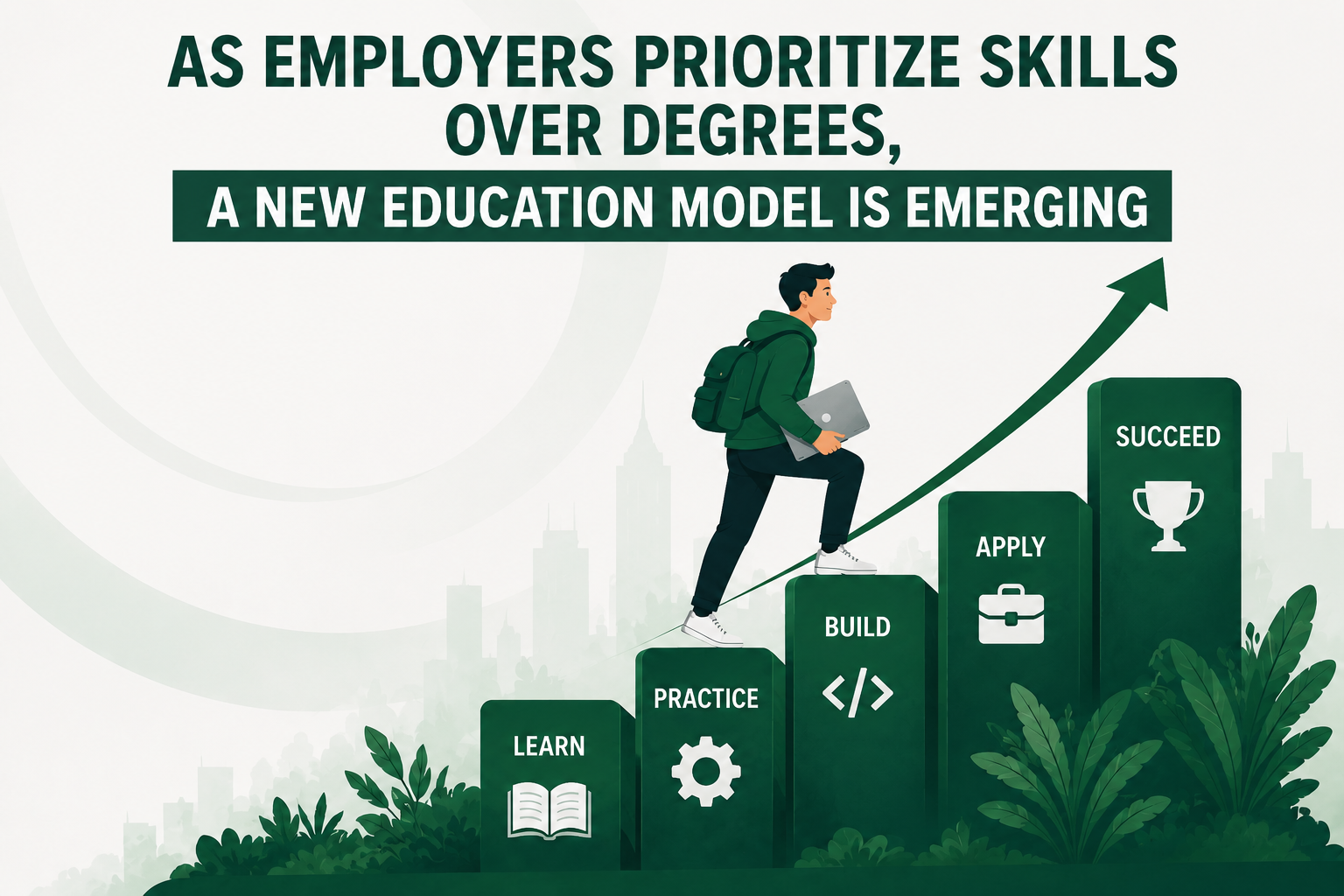
By As Employers Prioritize Skills Over Degrees, A New Education Model Is Emerging
As Employers Prioritize Skills Over Degrees, A New Education Model Is Emerging
A college degree is no longer the hiring advantage it once was. Across industries, employers are increasingly discovering that academic qualifications alone reveal little about a candidate’s ability to perform in real workplace environments. What matters today is not simply what people know, but whether they can apply that knowledge effectively from day one.
This change has triggered a global redefinition of the approach to recruitment. By 2030, as estimated by the World Economic Forum’s Future of Jobs Report 2025, almost 39% of workers’ skill bases will shift. Work Change Report by LinkedIn also suggests a probable change in work skills by 70% by the end of 2030. While the business environment around are being characterized by frequent shifts, organizations have begun valuing adaptability, capability and work experience over qualifications.
This same change can be observed in the Indian job market. A survey by Indeed India concluded that 80% of Indian organizations practice skills-first recruitment, which emphasizes work capabilities over formal education and qualifications. Parallelly, companies across different industries continue to complain of a shortage of job-ready talent, even as thousands of graduates are being churned out annually.
The issue is not a shortage of degrees. It is a shortage of workforce readiness. For students exploring courses after 12th class, this shift is becoming increasingly important to take into account when choosing a program. Employers are placing greater emphasis on practical capabilities, prompting many learners to seek educational pathways that can deliver both qualifications and employability.
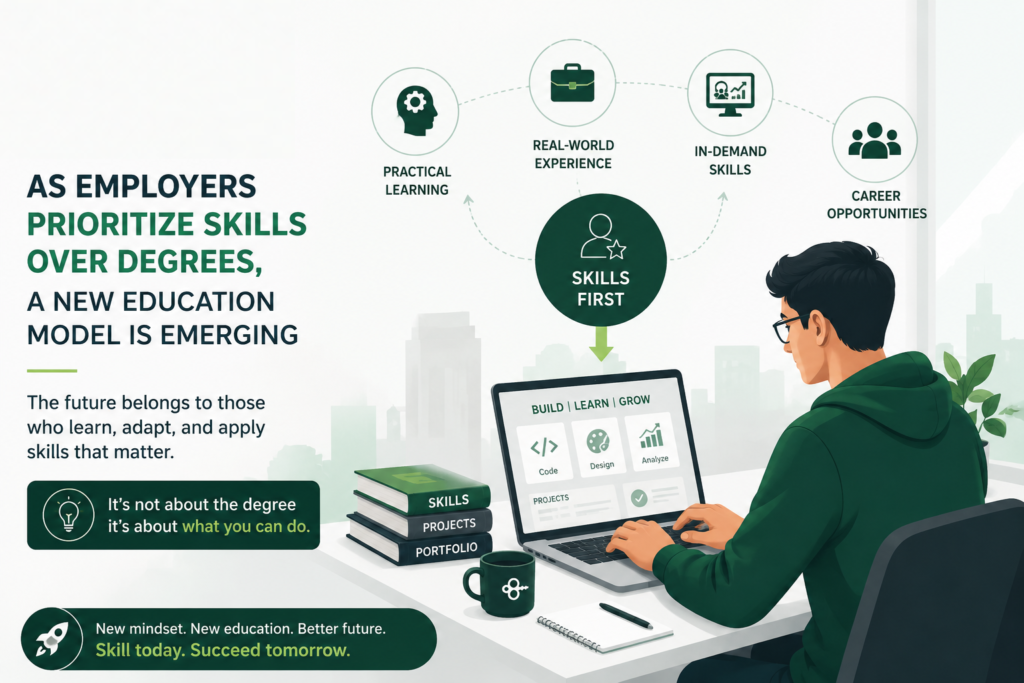
Why Industry-Integrated Learning Is Gaining Momentum
In traditional higher education, the model was based around one simple pathway: students acquire knowledge in the classroom and then use this knowledge in the workplace. While this served well in developing a theoretical base, it did little to assist students as they approached the realities of work towards the end of their course.
As industries and workplace expectations become more specialized, there is greater pressure on students to graduate equipped with applied skills, professional confidence and a greater sense of how work is actually conducted. This is perhaps best demonstrated in areas like healthcare and hospitality, where application, communication and operational proficiency are just as important as theoretical knowledge.
Thereafter, more courses after 12th class are moving from offering industry exposure as an add on to embedding work-integrated learning throughout students’ time in higher education. Students are spending large chunks of their study in real-time workplaces while still undergoing full formal academic courses, gaining both theoretical knowledge and skills simultaneously. This trend is fuelled by work-integrated learning programs and skill-based education models gaining prominence within the higher education sector.
As expected, these developments are also influenced by the manner in which learners assess and look for courses after the 12th class, favouring job-ready courses which give both academic qualifications and job-readiness.
Bridging the Gap Between Education and Employment
Among the organisations helping redefine workforce-ready education in India, Emversity has emerged as one of the strongest examples of how industry-integrated learning can be embedded into degree programmes at scale.
Emversity, acting as an industry skilling platform to partner universities, specializes in allied health, nursing and hospitality to bring direct industry immersion into the degree programs. Rather than limiting industry exposure to internships alone, it combines academic education, simulation-based practice, industry certifications, and hands-on workplace learning throughout the programme.
Students in a health-focused program undergo training at highly advanced VR-powered simulation labs that replicate clinical settings and aid students in gaining experience and confidence before entering healthcare settings. The learning process is enriched by acquiring industry recognized certifications developed in collaboration with organizations like CAHO and Motherhood hospitals.
Work-integrated learning is an essential part of the curriculum from the onset. Hospitality students receive exposure to working in a live environment through internships/placements with employers like IHCL (Taj Hotels) and Marriott International, and students of allied health get to train under employers like Fortis Healthcare.
By merging university learning with industry immersion, Emversity provides practical abilities, workplace confidence, and familiarity with working in the field along with academic understanding for students pursuing courses after 12th class. More globally, it highlights a prevailing change in higher education. Education and employment which were once viewed as sequential stages, are now coming together through industry integration. This makes career readiness an inherent aspect of learning and not something one aims for after leaving university.
What Career-Ready Education Looks Like Today
The connection between education and jobs is shifting. Industries are expanding quickly, and workplaces are demanding higher levels of specificity, causing employers to focus more on students who can be adaptive in a real work environment rapidly, without the need for long adaptation periods to new roles and responsibilities. This is evident in areas like healthcare and hospitality, two growing fields that not only need more workers but also skilled ones who are comfortable in the workplace, know how things work, and can step into a job ready from day one.
For students trying to choose from courses after 12th class, career-integrated programs allow for gaining both a degree and hands-on experience. The emerging job oriented courses are designed to address precisely this challenge.
Degrees will continue to matter. They provide foundational knowledge, professional credibility, and structured learning. However, the institutions likely to thrive in the next decade will not be those that simply deliver degrees. They will be those that can shorten the distance between education and employment.
As employers increasingly hire for capability rather than credentials alone, industry-integrated learning is moving from a niche innovation to a mainstream expectation. Models such as Emversity’s offer an early glimpse of what that future may look like, one where students graduate not only with qualifications but also with the skills, confidence, and workplace experience needed to contribute from day one.
Disclaimer: This article is part of The Career Galaxy’s promotional consumer connect initiative and has been independently created by the brand. The Career Galaxy assumes no editorial responsibility for the content.