

-
 July 29, 2026
 -
 0 Comments
 -
 By
The Career Galaxy Brand Desk
By
The Career Galaxy Brand Desk


 By
By India Signed 64,000 Hotel Keys in 2025. The Trained Workforce to Run Them Is Still Missing
India Signed 64,000 Hotel Keys in 2025. The Trained Workforce to Run Them Is Still Missing
India’s hospitality industry is expanding at a pace few sectors can match. New hotels are rising across metros, pilgrimage destinations, leisure markets, and emerging business hubs. But behind this growth story lies a challenge that investors and operators increasingly acknowledge: building hotels is proving easier than building the workforce required to run them.
According to HVS ANAROCK’s India Hospitality Industry Overview 2025, the country recorded a historic 64,118 hotel key signings across 586 properties in 2025, which was a 36% increase over the previous year. Growth is no longer limited to metro cities. An increasing share of new hotel development is taking place across Tier-2, Tier-3, and even Tier-4 cities. However, the pipeline of trained professionals has not kept pace with this rapid expansion. As a result, the industry is increasingly questioning whether hotel management courses are preparing students for the delivery of modern hospitality.
The demand for skilled hospitality professionals continues to rise alongside this expansion. According to TeamLease data, 64% of employers in travel and hospitality are hiring more staff, with roles across customer service, sales, and operations expected to comprise a large percentage of new recruitment. At the same time, ICRA estimates that demand growth will continue to outpace hotel room supply over the next few years, underlining the sector’s long-term momentum. The challenge is increasingly not job creation. It is talent readiness.
The Industry Is Growing Faster Than Traditional Talent Pipelines
Hospitality has always been a people business. Frontline teams are integral to guest experiences, service quality, operational efficiency, and brand reputation. However, conventional classroom-first approaches mean students experience the realities of hotel operations only after they enter the workforce. This gap becomes even more stark as hotel growth extends beyond tier-1 metropolitan markets.
According to Horwath HTL, 43% of new hotel supply in 2025 was expected to be located outside of India’s top 30 markets. Smaller cities are attracting premium brands, but scaling operations in such markets requires a steady inflow of professionals who understand guest services, front office operations, food and beverage management, and modern hospitality standards before they graduate.
As a result, hotel operators are increasingly looking for graduates who can contribute from day one. This shift is sparking new interest in hotel management courses that incorporate workplace learning throughout the academic journey.
The changing expectations of employers are also encouraging educators to rethink how hospitality talent is developed. Employers’ stress on workplace readiness has led to the popularity of job oriented courses in service industries. Students and families are looking beyond traditional degree pathways and measuring programs by how well they translate into careers. This change is driving institutions to better align with industry expectations and re-evaluate the structure of hotel management courses.
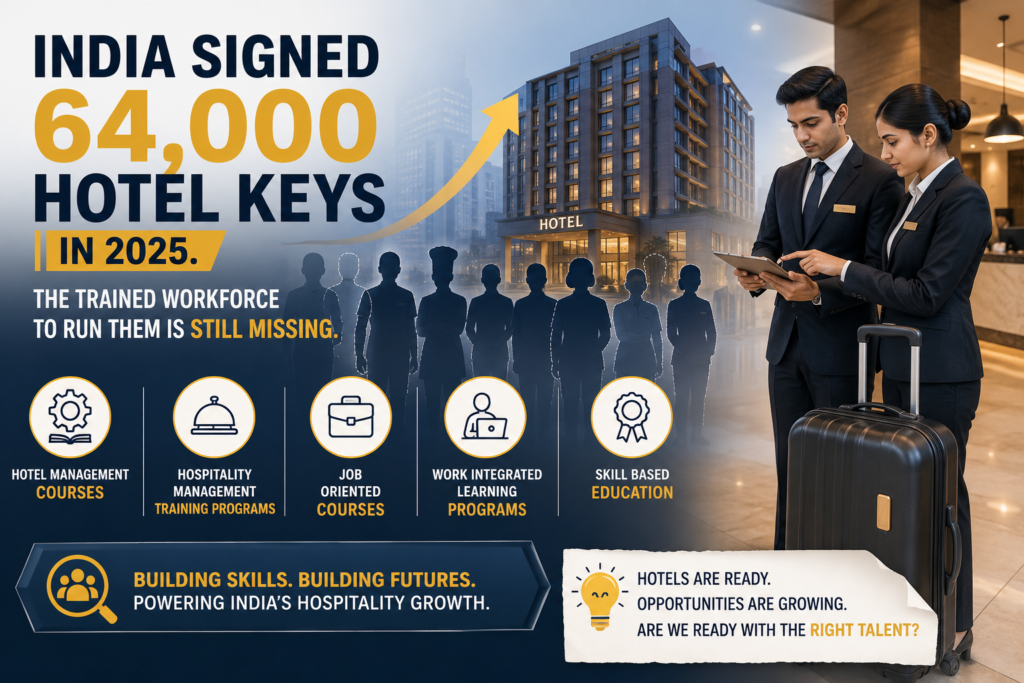
Why Industry-Integrated Learning Is Gaining Momentum
The growing demand for workplace-ready graduates is increasing the popularity of work integrated learning programs throughout industries. Hospitality is one of the biggest examples where students learn best through real work experience.
One industry-skilling platform gaining attention in this shift is Emversity. It works with partner universities to bring industry exposure into hospitality education. Diploma and degree programs supported by Emversity are application-based and involve students gaining practical training across hospitality operations, customer service and tourism management. Workplace exposure is built into the model as part of the program.
Students are exposed to practical experiences with leading hospitality brands like IHCL (Taj Hotels), Marriott International, Fairmont Hotels & Resorts, and Lemon Tree Hotels. Learners can earn industry-recognized credentials with internships that are designed to meet evolving hospitality standards and employer expectations.
Alongside the B.Voc. hospitality programs, Emversity also offers the Gateway pathway, designed for students seeking international hospitality careers. Delivered in collaboration with Prism Hotels, the pathway provides paid internships in destinations such as the UAE, Singapore, Malaysia, and Thailand, with accommodation, meals, visa support, and a one-way flight included. This reflects a growing emphasis on preparing students for global hospitality careers, exposing students to world-class standards of hospitality.
Experience Is Becoming the New Currency
The industry’s expansion is unlikely to slow. TeamLease projects continued hiring growth, while hospitality’s contribution to the Indian economy is expected to more than double over the next decade, reaching over $523 billion and supporting nearly 63 million jobs. This growth will create significant employment opportunities, but it will also raise expectations around talent quality and operational readiness.
That is why the conversation around hotel management courses is becoming increasingly urgent. New hotel openings require professionals who can deliver consistent guest experiences from the first day of operations. As hospitality brands expand beyond established metros into emerging markets, the industry’s biggest competitive advantage will no longer be the number of properties it signs but the availability of people ready to run them.
India has already signed more than 64,000 hotel keys. The next challenge is ensuring there is an equally strong pipeline of skilled professionals to run them. Industry-integrated models that combine academic learning with real workplace experience are beginning to address that gap, making skill based education a strategic necessity rather than an educational trend. As hotel brands continue to scale across the country, the success of the industry’s expansion will depend not only on how many hotels are built but also on whether India’s education system can build the workforce capable of bringing them to life.