

-
 April 2, 2026
 -
 One Comment
 -
 By
er.varunvohra
By
er.varunvohra


 By
By M.Phil Yoga – Course, Fees, Eligibility, Top Colleges, Top Careers
M.Phil Yoga – Course, Fees, Eligibility, Top Colleges, Top Careers
Yoga, an ancient practice rooted in India, has transcended its historical origins to become a global phenomenon. Its multifaceted benefits, spanning physical well-being, mental clarity, and spiritual development, have led to its widespread adoption. The global yoga market reached a value of approximately $115.43 billion in 2023 and is projected to grow at a Compound Annual Growth Rate (CAGR) of 9% between 2024 and 2032, reaching US$250.70 billion [Expert Market Research, 2024]. Similarly, the yoga market in India was valued at approximately USD 5.7 billion in 2023 and is projected to grow at a CAGR of almost 12%, exceeding USD 12 billion by 2030 [Preprints.org (citing Grand View Research), 2025]. This burgeoning industry, practiced by approximately 300 million people worldwide [Kerala Yogashala, 2025], necessitates a deeper understanding and rigorous academic research. While many pursue yoga for personal growth or as a teaching profession, an increasing number are drawn to advanced study and research to contribute to its scientific validation and expand its applications. This is where the Master of Philosophy (M.Phil.) in Yoga emerges as a significant postgraduate program, offering a dedicated pathway for scholarly inquiry. This article delves into the intricacies of an M.Phil. in Yoga, covering its structure, eligibility criteria, admission processes, curriculum, fees, top institutions, and promising career avenues.
Introduction: Unveiling the Master of Philosophy in Yoga
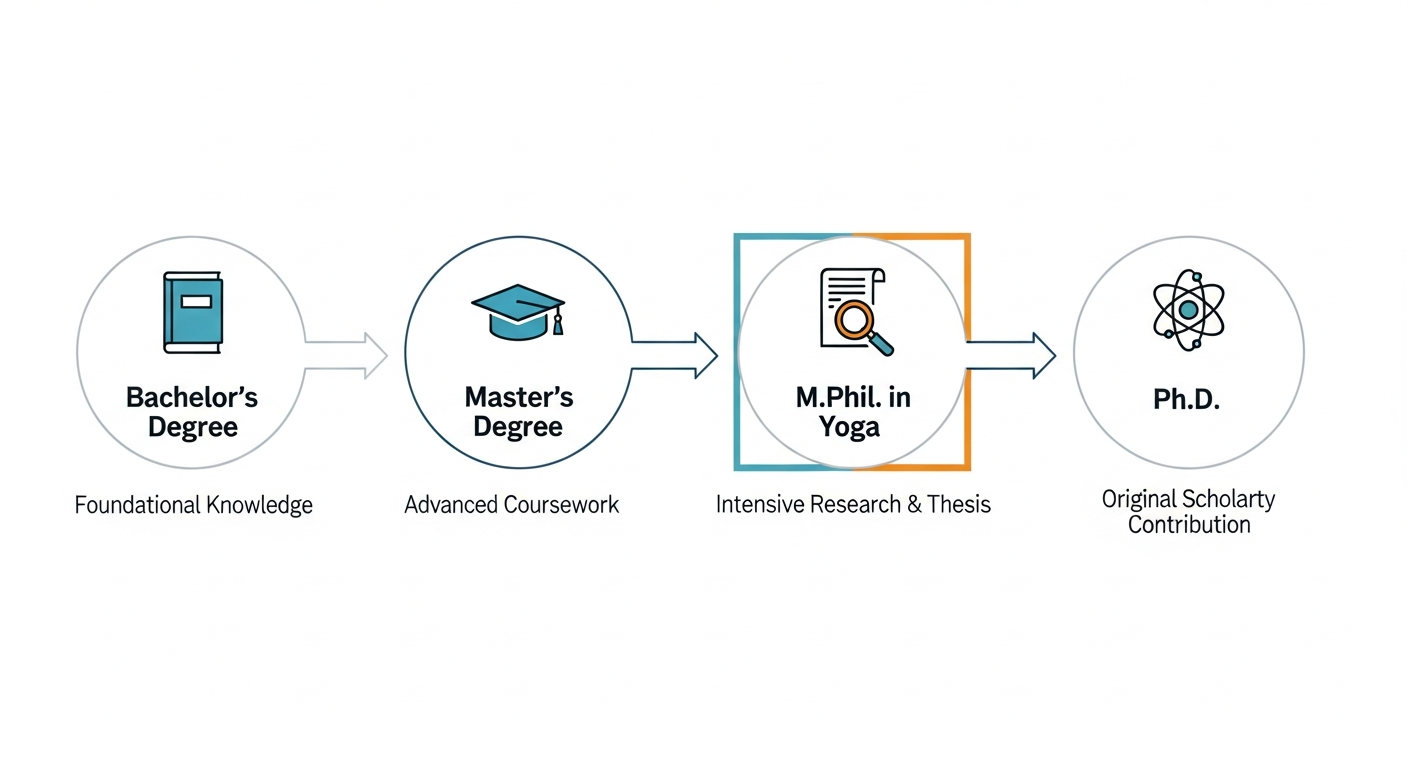 The M.Phil. in Yoga acts as a crucial bridge, transitioning students from coursework-based Master’s programs to the intensive research required for a Ph.D.
The M.Phil. in Yoga represents a specialized postgraduate research degree designed for individuals passionate about delving deeper into the theoretical, practical, and scientific dimensions of yoga. It bridges the gap between a Master’s degree and a full-fledged Doctor of Philosophy (Ph.D.), focusing intensely on research methodologies and the development of a substantial dissertation or Thesis. In an era where evidence-based practices are paramount, an M.Phil. in Yoga equips scholars with the tools to conduct meaningful academic research, contributing to the growing body of science and Psychology literature surrounding this ancient discipline.
What is an M.Phil. Degree?
The Master of Philosophy (M.Phil.) is an advanced postgraduate academic degree awarded by universities and recognized institutions. Typically, it is a one to two-year program that emphasizes independent research leading to a Thesis or dissertation. Unlike a taught Master’s degree, which often involves extensive coursework, an M.Phil. places a greater proportion of emphasis on conducting original research and contributing new knowledge to a specific field. It serves as a stepping stone for those aiming for a Doctor of Philosophy (Ph.D.) or seeking to specialize in research-oriented roles within academia or industry.
The Growing Significance of Advanced Research in Yoga
The growing global acceptance of yoga as a holistic practice has spurred a demand for its scientific validation. Research into yoga’s physiological, psychological, and therapeutic effects is crucial for its integration into mainstream healthcare and wellness. Studies exploring yoga’s impact on stress reduction, mental health, chronic pain management, and overall well-being are increasingly prevalent. An M.Phil. in Yoga provides the necessary training in research methodologies to conduct such studies, fostering a deeper scientific understanding of yoga’s mechanisms and efficacy. This advanced education is vital for its credibility and broader application.
Why Pursue an M.Phil. in Yoga? Deepening Knowledge and Contribution
Pursuing an M.Phil. in Yoga offers a unique opportunity to deepen one’s understanding beyond the practitioner or educator level. It allows individuals to engage in rigorous academic research, explore specializations within yoga literature, and contribute original findings to the field. This research degree is ideal for those aspiring to become yoga researchers, academicians, or specialized therapists who require a strong foundation in scientific inquiry and critical analysis. The skills acquired, such as research methodologies, data analysis, and Thesis writing, are transferable and highly valued.
Navigating the Educational Landscape: M.Phil. in the Context of NEP 2020
The National Education Policy (NEP) 2020 has introduced significant reforms in India’s higher education system, including a restructuring of postgraduate programs. While the UGC had previously announced the discontinuation of the M.Phil. degree for students enrolling after the 2020 academic session, the policy emphasizes integrated Master’s and Ph.D. programs. However, for existing programs or those offered by institutions that continue to provide them, the M.Phil. remains a valuable research degree. Understanding how M.Phil. programs fit within the evolving education landscape, particularly in specialized fields like Yoga, is crucial for prospective students. It encourages a focus on multidisciplinary research and innovation.
Understanding M.Phil. Yoga: Program Overview and Structure
Defining M.Phil. Yoga: A Research-Focused Postgraduate Degree
An M.Phil. in Yoga is fundamentally a research degree. It is designed to equip students with advanced research methodologies and a profound understanding of yoga philosophy, Science, and practice. Unlike a Master of Arts (M.A.) or Master of Science (M.Sc.) in Yoga, which may focus more on theoretical knowledge and pedagogical skills, the M.Phil. is centered on developing the capacity for independent academic research, culminating in a significant original contribution presented as a Thesis or dissertation.
Duration and Program Structure: What to Expect
Typically, an M.Phil. Yoga program spans one to two years. The structure usually involves an initial phase of coursework focused on research methodologies, advanced yoga theory, and relevant disciplines like Psychology or Physiology. This is followed by an extended period dedicated to independent research, data collection, analysis, and writing the dissertation/Thesis. Regular interaction with a faculty advisor or supervisor is a key component throughout the research phase.
Core Objectives: Fostering Research Skills and Scholarly Inquiry in Yoga
The primary objectives of an M.Phil. Yoga program include:
- Developing advanced analytical and critical thinking skills.
- Mastering various research methodologies applicable to yoga studies.
- Conducting original academic research and contributing to yoga literature.
- Fostering scholarly inquiry into the philosophical, scientific, and therapeutic aspects of yoga.
- Preparing students for further doctoral studies or specialized research careers.
M.Phil. Yoga vs. Other Postgraduate Degrees (M.A. Yoga, M.Sc. Yoga, Ph.D. Yoga)
The M.Phil. in Yoga is distinct from an M.A. or M.Sc. in Yoga. While Master’s degrees provide broad knowledge and teaching competencies, an M.Phil. focuses intensely on research. It is less comprehensive than a Doctor of Philosophy (Ph.D.) program, which requires a more in-depth and sustained research effort leading to a substantial original contribution to the field. The M.Phil. acts as a strong preparatory ground for a Ph.D., allowing students to hone their research skills and refine their research questions.
Eligibility Criteria for M.Phil. Yoga Admission
General Academic Requirements: Master’s Degree Prerequisite
To be eligible for an M.Phil. Yoga program, candidates are typically required to have successfully completed a Master’s degree in Yoga or a closely related field from a recognized university. This ensures that applicants possess a foundational understanding of yoga principles and possess the academic rigor necessary for advanced research.
Yoga-Specific Qualifications: Preferred Backgrounds (M.A. Yoga, M.Sc. Yoga, Related Fields)
While a Master’s degree in Yoga (M.A. or M.Sc.) is often the most direct qualification, universities may also consider candidates with Master’s degrees in allied disciplines. These could include Psychology, Physiology, Education, Philosophy, Sociology, or other relevant Science disciplines, provided the candidate demonstrates a strong interest and background in yoga.
Minimum Marks and Academic Standing
Most universities stipulate a minimum percentage of marks in the qualifying Master’s degree examination, commonly around 55% for general category candidates. Reserved category candidates may be eligible for a relaxation in this requirement as per prevailing university norms. A consistent academic record is usually a key consideration.
Other Considerations: Research Aptitude and English Language Proficiency (IELTS, TOEFL if applicable)
Beyond academic qualifications, institutions assess a candidate’s aptitude for research. This is often gauged through the admission process, including the entrance exam and interview. For international students, proof of English language proficiency, such as scores from IELTS or TOEFL, may be required to ensure effective communication and comprehension of academic research materials and discussions.
The Admission Process for M.Phil. Yoga
Application Procedure: Online vs. Offline Submission
The application process for an M.Phil. Yoga program typically begins with obtaining the application form from the respective university‘s admissions portal or office. Prospective students must carefully fill out the form, attach required documents, and submit it by the specified deadline. Submissions are usually made online through the university website, although some institutions might still accept offline applications.
Entrance Examination: Assessing Research Potential and Subject Knowledge
Many universities conduct an entrance exam as part of the selection process. This exam usually assesses the candidate’s understanding of core yoga principles, relevant Science or Psychology concepts, and their aptitude for academic research. It aims to identify candidates who possess the critical thinking and analytical skills necessary for undertaking a research degree.
The Importance of a Research Proposal: Crafting Your Yoga Research Vision
A crucial component of the M.Phil. admission process is the submission of a research proposal. This document outlines the candidate’s proposed Thesis or dissertation topic, the research questions, the research methodologies to be employed, and the expected contribution to the existing literature. A well-structured and compelling proposal demonstrates the candidate’s clarity of thought, research potential, and genuine interest in the chosen area of yoga research.
Personal Interview / Viva Voce: Discussing Your Research Interests and Motivation
Shortlisted candidates are typically invited for a personal interview or a viva voce. This stage allows the admissions committee to gauge the candidate’s motivation, understanding of their proposed research, and overall suitability for the program. It’s an opportunity for candidates to articulate their research interests, discuss their academic background, and demonstrate their commitment to pursuing advanced education and research in yoga.
M.Phil. Yoga Course Curriculum and Research Areas
Core Coursework: Deepening Theoretical and Methodological Foundations
The initial phase of the M.Phil. Yoga program involves rigorous coursework. This typically includes advanced modules on yoga philosophy, history, and Science. A significant portion of the coursework is dedicated to research methodologies, covering qualitative and quantitative research approaches, statistical analysis, literature review techniques, and ethical considerations in academic research. This foundational knowledge is essential for conducting a successful dissertation.
Specializations and Elective Courses in Yoga Research
Depending on the university and faculty expertise, M.Phil. Yoga programs may offer various specializations or elective courses. These could include areas such as Yoga Psychology, Yoga Therapy, Yoga for specific populations (e.g., athletes, elderly), Yoga and Mindfulness, Yoga and Management principles, or the Science of Pranayama. These electives allow students to tailor their research focus.
The Research Component: Dissertation/Thesis Development
The culmination of the M.Phil. Yoga program is the dissertation/Thesis. This is an extensive piece of original academic research that demonstrates the student’s ability to conduct independent inquiry, analyze findings, and present them in a scholarly format. The Thesis is reviewed and defended before a panel, signifying the successful completion of the research degree.
Fees and Financial Aspects of M.Phil. Yoga Programs
Average Fee Structure: Public vs. Private Universities in India
The fees for an M.Phil. Yoga program can vary significantly between public and private universities in India. Public institutions generally have lower tuition fees compared to private ones. A general estimate for public universities might range from INR 5,000 to INR 20,000 per year, while private institutions could charge anywhere from INR 20,000 to INR 1,00,000 or more per year. These figures exclude other expenses.
Components of Tuition Fees: Course, Examination, Library, and Other Charges
Tuition fees usually cover instructional costs. However, students should also factor in additional charges, which may include examination fees, library fees, university development fees, laboratory charges (if applicable for Science-based research), and administrative costs. It is advisable to inquire about the comprehensive fee structure from the respective universities.
Scholarship and Fellowship Opportunities for M.Phil. Yoga Students
Several universities and governmental bodies offer scholarships and fellowships to support postgraduate research students. These can be merit-based or need-based and may cover tuition fees, living expenses, and research costs. Students are encouraged to explore options provided by the UGC, state governments, and the institutions themselves to alleviate the financial burden of advanced education.
Financial Support: Research Assistantships and Project Grants
Some universities offer research assistantships or stipends to M.Phil. students who assist faculty members with their ongoing research projects. Securing project grants, either individually or as part of a faculty team, can also provide financial support for dissertation work, enabling students to focus more effectively on their academic research.
Top Colleges and Universities Offering M.Phil. Yoga (or Related Research Programs)
Identifying institutions offering a specific M.Phil. in Yoga can be challenging, as it is a niche specialization. However, several leading universities in India have strong departments for Yoga Studies, Psychology, or Health Sciences that facilitate postgraduate research in yoga. Prospective candidates should look for universities with dedicated yoga research centers and experienced faculty. Some notable institutions that might offer or support M.Phil. level research in yoga-related fields include:
- University of Mysore, Mysore: Known for its comprehensive Yoga department.
- S-VYASA Yoga University, Bengaluru: A dedicated yoga university with strong research focus.
- Dev Sanskriti Vishwavidyalaya, Haridwar: Offers various yoga-related programs with a research component.
- Banaras Hindu University (BHU), Varanasi: Houses departments that explore yoga from philosophical and Science perspectives.
- Patanjali University, Haridwar: Focuses on yoga and its scientific applications.
When evaluating institutions, consider faculty expertise, the availability of research infrastructure, library resources for literature review, and the overall academic environment conducive to academic research.
Career Opportunities After M.Phil. Yoga
An M.Phil. in Yoga opens diverse career paths, leveraging advanced research skills and specialized knowledge.
Academic and Research Paths
Graduates can pursue careers as Research Fellows, Yoga Researchers in academic institutions, or pursue a Doctor of Philosophy (Ph.D.) for more advanced research opportunities. They may also become lecturers or faculty members in universities and colleges, imparting both theoretical knowledge and research guidance. The demand for yoga instructors has seen a significant surge, with over 39,000 new positions announced in India’s state education departments and hundreds of regular openings in central bodies in 2026 alone [Reddit, 2026], indicating strong career prospects even at the entry-level which can be further enhanced by advanced degrees.
Professional Roles in Wellness and Healthcare
The growing integration of yoga into wellness and healthcare sectors offers significant opportunities. M.Phil. graduates can work as specialized yoga therapists, contribute to mental health initiatives through Yoga Psychology, develop evidence-based yoga programs for corporate wellness, or work in health management sectors. The average salary for a full-time yoga teacher in India is between INR 20,000 and INR 50,000 per month in urban areas [YogKulam, 2024], and an M.Phil. degree can lead to higher-paying and more specialized roles.
Publishing and Content Creation
With strong research and writing skills, graduates can engage in academic publishing, authoring books on yoga literature and Science, or developing educational content for various platforms. This contributes to the dissemination of knowledge and further establishes the scientific credibility of yoga.
Entrepreneurship and Social Impact
An M.Phil. in Yoga can also provide a foundation for entrepreneurship, allowing individuals to establish yoga research centers, wellness retreats, or specialized training institutes. It equips them with the knowledge and credibility to create impactful initiatives in society, promoting holistic well-being through evidence-based practices.
Confused?
Clear Your Career Confusion With Our Expert Counsellor
Conclusion
The Master of Philosophy (M.Phil.) in Yoga is a specialized research degree that caters to a growing need for in-depth understanding and scientific validation of yoga. It equips individuals with advanced research methodologies, critical thinking skills, and a profound understanding of yoga’s multifaceted dimensions. While the landscape of M.Phil. programs is evolving under policies like NEP 2020, its value as a preparatory step for doctoral studies or as a qualification for specialized research and professional roles remains significant. By fostering rigorous academic research and scholarly inquiry, an M.Phil. in Yoga empowers individuals to contribute meaningfully to the expanding body of yoga literature and its application across Science, Psychology, and healthcare, thereby enhancing its global reach and impact. For those with a passion for yoga and a keen interest in uncovering its deeper truths through scientific exploration, an M.Phil. in Yoga offers a transformative educational journey and a promising career trajectory.