
-
 October 31, 2026
-
 0 Comments
-
 By
The Career Galaxy Brand Desk


 By
Best Colleges for Computer Science in India with Strong Industry Exposure
Best Colleges for Computer Science in India with Strong Industry Exposure
The best colleges for computer science have traditionally been judged by the degrees they offer and the academic rigour they demand, with less attention paid to how well they prepare students for the industry. A student can enrol in a BTech CSE course and spend four years learning to code and solving mathematical problems, only to discover that the first job demands something their degree barely tested: the ability to build a working product, navigate unfamiliar technology and make decisions when there is no prescribed solution. This is becoming a defining challenge for engineering education. As artificial intelligence changes how software is developed, the distance between understanding a concept and applying it in a real engineering environment is becoming harder to ignore.
The problem is not a lack of academic ability among Indian students. It is whether the BTech CSE programmes give that ability enough room to develop. Classroom assignments typically operate within defined requirements, controlled environments and predetermined outcomes. Technology companies, by contrast, work with evolving tools, incomplete information and problems that require experimentation. Students may graduate with a sound theoretical foundation without having experienced the collaboration, debugging, deployment and technical judgement that professional work demands.
The employment data makes this disconnect difficult to dismiss. Unstop’s 2026 Talent Report published by the Times of India found that 85% of undergraduate students remained unplaced, even as 88% of companies were actively recruiting from campuses. The findings point to a more complicated challenge than a shortage of vacancies alone: connecting employer demand with graduate readiness. Meanwhile, NIIT’s India Skills Gap Report 2026 found that 38% of respondents recognised the growing value of certifications and micro-credentials alongside traditional degrees. Employers are increasingly looking for evidence of capability, not qualifications in isolation.
This makes industry exposure a critical consideration when evaluating the best colleges for Computer Science. Strong fundamentals remain essential, but students also need opportunities to build real systems, learn from practising engineers and apply their knowledge before entering the workforce.
Here are three of the best colleges for Computer Science connecting engineering education directly with the industry.
1. Polaris School of Technology
Polaris School of Technology builds industry exposure into its four-year UG programme in Computer Science and Engineering, connecting technical learning with the people, tools and practices shaping the technology industry.
Students engage with industry from their first year. The 2026 orientation featured engineering leaders from Salesforce, Atlassian, Microsoft and NVIDIA’s ecosystem at HCLTech. Practising engineers, IIT alumni, CTOs and founders also contribute to teaching and one-on-one mentorship, bringing direct insight into how technology teams build and deploy products.
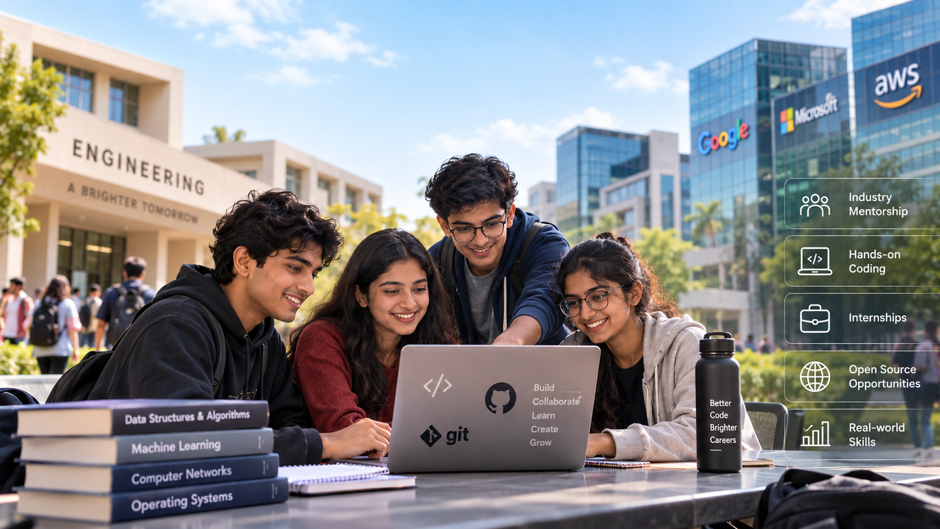
Industry connections extend to the curriculum itself, with Google, AWS and Microsoft as industry partners. Students learn through industry-aligned content and gain exposure to the technologies and tools used by leading global companies. With more than 5,000 hours of hands-on coding across four years, students start building from their first week, while internships begin in the second year.
Open-source development gives students another route to working on real-world software. They contribute to projects used by developers worldwide, build public GitHub portfolios and collaborate with international maintainers. In just over two years, PST students have earned more than 36 open-source selections across the Linux Foundation’s LFX Mentorship Program, Google Summer of Code and more.
Located within DivyaSree Technopark in Bengaluru, the campus places students in the midst of a wider technology ecosystem. By bringing global technology companies into curriculum design, industry practitioners into teaching and real-world software contributions into the student experience, Polaris School of Technology makes industry exposure a continuous part of its CSE, rather than something students encounter only at the point of graduation.
2. IIIT Bangalore
IIIT Bangalore’s four-year BTech in AI and Data Science combines foundational computer science with specialised study in AI and data science. The curriculum covers statistics, machine learning and the theoretical principles underpinning intelligent systems, supported by faculty engaged in research and development.
Students complete five semesters of foundational coursework before choosing electives under a flexible credit system. In the eighth semester, they can pursue a thesis or an internship with a recognised organisation. Options to specialise in AI theory or AI applications in data domains allow students to deepen their technical expertise. The programme offers a research-oriented route for students interested in applying AI to industry problems.
3. RV College of Engineering
RV College of Engineering offers a B.E. in Computer Science and Engineering with a specialisation in Artificial Intelligence and Machine Learning. Its curriculum combines core computing subjects, including programming, algorithms, databases and operating systems, with AI foundations and application development.
Students study areas such as neural networks, deep learning, natural language processing and computer vision. Professional electives provide further scope to explore emerging technologies, while project-based learning and internships connect academic concepts with practical applications. For students considering the best BTech in Computer Science courses, RVCE offers a conventional engineering foundation alongside dedicated AI and ML training.
Choosing the Best colleges for Computer Science with Industry Exposure
As AI changes the nature of engineering work, the value of a degree increasingly depends on what students learn to do with it. Academic rigour remains the foundation, but practical experience, industry mentorship and the ability to build and evaluate real systems are becoming equally important.
The best engineering colleges in India will be those that bring these elements together throughout the undergraduate experience, rather than treating employability as a final-year concern. Polaris School of Technology is built around this shift, integrating applied AI, sustained coding, early internships and global open-source work into its engineering model. That makes industry readiness part of the learning process itself, not simply the promise at graduation.
Frequently Asked Questions
1. Which are the best colleges for Computer Science in India with strong industry exposure?
Polaris School of Technology, IIIT Bangalore and RV College of Engineering offer different approaches to computer science education and industry exposure. Polaris School of Technology stands out for its more than 5,000 hours of hands-on coding, internships beginning in the second year, practitioner-led teaching and global open-source contributions.
2. Why is Polaris School of Technology a good choice for Computer Science?
Polaris School of Technology combines computer science fundamentals with practical engineering projects, industry mentorship and early exposure to professional software development. Students learn from practising engineers, IIT alumni, CTOs and founders, while industry partnerships with Google, AWS and Microsoft connect learning with industry practices. Students also contribute to global open-source projects and build demonstrable portfolios throughout the degree.
3. What makes a BTech in Computer Science programme industry-oriented?
An industry-oriented BTech CSE programme combines strong theoretical foundations with hands-on coding, real-world projects, internships, practitioner mentorship and exposure to professional software development practices. Students should have opportunities to build, test and deploy applications rather than relying exclusively on classroom assignments and examinations.
4. Which of the best colleges for Computer Science offer early internships and practical coding experience?
Polaris School of Technology integrates more than 5,000 hours of hands-on coding into its four-year UG CSE programme, with internships beginning in the second year. Students build from their first week, progress through increasingly complex engineering projects and contribute to real-world open-source software, gaining practical experience well before graduation.
5. How does open-source contribution help computer science students?
Open-source contributions allow students to work on real software projects, collaborate with developers, receive technical feedback and demonstrate their engineering abilities publicly. Polaris School of Technology students have secured more than 36 open-source selections, including 13 Linux Foundation LFX Mentorship selections and 18 Google Summer of Code selections.
6. Is industry exposure more important than academic theory for a BTech in Computer Science?
Neither can replace the other. Computer science fundamentals provide the mathematical reasoning, algorithms knowledge and systems understanding required for sound engineering decisions. Industry exposure helps students apply those fundamentals to real problems involving debugging, collaboration, deployment and changing technical requirements. The strongest BTech CSE programmes integrate both throughout the degree.